
2026 Market Insights for Consultants
This report frames the market pressures reshaping self-funded employer benefits decisions in 2026 and the proof points consultants will need from TPA partners to defend recommendations with confidence.
01
The Accountability Mandate
Your clients are now asking you to prove it.
Large employers are asking consultants to demonstrate more than price and familiarity. They increasingly expect advisors to show why a recommended partner deserves the business, how that partner performs, and what evidence
supports the recommendation.
The market has moved from trust-based recommendation to documented evaluation. For a consultant, the central question is no longer which TPA is largest or most familiar—it is which TPA can withstand scrutiny.
Business Group on Health documents the new standard in plain language: consultants and advisors must “comprehensively articulate, demonstrate and thoroughly evaluate” every partner they recommend. Vendors are expected to “clearly articulate the value of their offerings, providing robust data and validation of clinical and service outcomes.”
This is not a trend toward accountability. It is accountability, documented, as the current expectation of the large employer market. The consultant who cannot produce that data from their TPA partner is starting every renewal conversation at a disadvantage.
The fiduciary stakes
The fiduciary and transparency stakes are intensifying. While ERISA obligations are not new, recent litigation and expanding transparency expectations are putting greater scrutiny on how employers—and the consultants advising them—evaluate plan service providers.

~80%
of self-funded employers already work with a large consultant. The question is whether that consultant has the evidence needed to stand behind the TPA recommendation.

~79%
of employers turn to their brokers and benefits advisors to identify and evaluate benefits choices. The consultant is the primary decision-making intermediary for the largest discretionary spend on most employers’ balance sheets.

4 in 10
employers would change their insurance carrier if that carrier cannot connect to their benefits technology platform. A TPA recommendation is now a technology recommendation—and it carries the consultant’s credibility.
Bigger ≠ Better
Recommending the biggest TPA is not the same as due diligence. When a CFO asks why you recommended a TPA under DOL scrutiny, market share is not a sufficient answer.
02
The Cost Crisis
The numbers your clients need you to understand better than anyone else in the room.
Four consecutive years of elevated cost growth, following a decade of increases averaging around 3%. The employers you advise are not managing a rough patch. They are managing a structural shift—and the consultants who can articulate that distinction with data are the ones who own the relationship.
The prescription drug factor—where the problem is accelerating
GLP-1 medications cost $1,000 to $1,500 per patient per month. 49% of large employers now cover them for weight loss, up from 44% in 2024—and 59% of those employers report utilization came in higher than expected. Employers are projecting another 11–12% pharmacy cost increase in 2026.
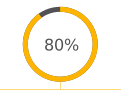
Of covered workers at large firms are in self-funded plans. Every one of those plans has a TPA behind it—and every one of those TPAs is either solving this problem or contributing to it.

Average annual cost per employee in 2025, a 6% increase above inflation plus wage growth. Projected to exceed $18,500 in 2026—the highest increase in 15 years.
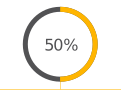
Cumulative healthcare cost growth for large U.S. employers since 2017. This number reframes the conversation from a renewal problem to a structural one.
03
Why Administration Quality Matters
Administration quality is where performance becomes visible.
Broad claims-denial statistics from provider revenue-cycle reporting are not the same as TPA-specific proof. A sophisticated consultant will notice the difference.
The better argument focuses on the operating areas that determine whether an administrator is disciplined, visible, and dependable: answer speed, first-call resolution, claims payment accuracy, financial accuracy, procedural accuracy, implementation readiness, account-management rigor, and audit frequency.
That framing is defensible because it mirrors how serious institutional buyers write contracts and enforce performance — not because it overclaims that every denial or every service failure in the broader healthcare system is a TPA problem.
What Poor Administration Looks Like
| EMPLOYERS EXPERIENCE | ROOT ADMINISTRATIVE CAUSE |
| Claim disputes | Accuracy issues |
| Long member wait times | Service center performance |
| Frustrated HR teams | Poor account management |
| Delayed implementations | Weak onboarding process |
| Lack of cost visibility | Insufficient reporting |
Performance Pays
When costs stay elevated, weak administration becomes more expensive. Poor visibility becomes less tolerable. TPA performance becomes central to the consultant’s recommendation.

04
The Procurement-Grade Standard
Four questions to ask any TPA. Most can’t answer all of them.
When large institutional plan sponsors put TPA administration out to bid, they specify performance standards contractually and enforce them through independent recurring audits. These benchmarks are the clearest available standard for what strong TPA administration looks like—more defensible than trade press, more specific than analyst surveys, more useful in a client conversation than anything a TPA’s sales team produces.
A note on claims accuracy—the benchmark being misused
The AMA’s finding that approximately 80% of large commercial insurer claims are processed correctly is often cited as the TPA benchmark. It is not. That figure describes the broad insurer category. When independent public auditors evaluate TPA performance, they set accuracy expectations in the high 90s across three distinct dimensions: payment accuracy, financial accuracy, and procedural accuracy. A TPA performing at the broad insurer baseline is significantly underperforming what serious buyers contractually require.
| QUESTION | WHY IT MATTERS | WHAT SOPHISTICATED BUYERS EXPECT |
| How fast do you answer the phone? | Speed to answer is the first moment of truth for member and employer experience. | Average speed to answer ≤ 30 seconds |
| Do you resolve issues on the first call? | First-call resolution predicts member satisfaction and repeat contracts. | First-call resolution rate ≥ 85% |
| How accurate are your claims? | Financial accuracy predicts plan dollars and reduces rework. | Claims financial accuracy ≥ 89% |
| What outcomes can you prove? | Attributable outcomes separate performance leaders from the rest. | One or more measurable outcomes with documented impact |

Sources: Nevada PEBP CTI Audits of UMR (public, recurring, independent); NYC Proposed Emblem/UMR Contract (public procurement);
Tennessee Plan RFP; Missouri MCHCP TPA Questionnaire and Audit Framework
05
Technology and Integration
The right test is not whether a TPA has an app.
Technology evaluation is about whether the TPA can fit into the employer’s actual ecosystem without lock-in, delay, or weak data access. The standard should focus on three criteria:
1Open integration architecture: any vendor, any platform, no proprietary lock-in
2Real-time claims visibility: on-demand for employer and members, not periodic batch reports
3Employer-facing analytics: proactive dashboards that surface cost drivers before the CFO asks
These are not abstract innovation claims. They are practical selection criteria that reflect how large employers actually operate — and how their consultants are now being held accountable for the partners they recommend.
4 in 10
employers would change their carrier if it cannot connect to their benefits technology platform. The integration expectation has become a hard selection criterion—not a nice-to-have.

Before recommending a TPA, consultants should ask:
- Can it integrate with existing benefits platforms without proprietary restrictions?
- Can employers and members access claims information on demand?
- Can reporting identify emerging cost drivers before renewal discussions begin?
- Can data be shared easily across the employer’s broader benefits ecosystem?
06
The Operational Proof Points Consultants Need
The operational metrics behind a defensible recommendation.
Sophisticated employers increasingly expect consultants to support recommendations with measurable operational performance—not broad capability claims. The strongest proof points are simple, repeatable, and easy to communicate in a client conversation: service responsiveness, operational accuracy, client satisfaction, and documented outcomes.
Show the work
Measurable operational outcomes increasingly carry more weight than broad capability claims. Consultants are expected to support recommendations with evidence that can withstand scrutiny.
| METRIC | HOW TO EXPRESS IT | WHY IT MATTERS TO CONSULTANTS |
| Average speed to answer | Single number in seconds; rolling 90-day average | Easy to compare to the public 30-second procurement expectation |
| First-call resolution rate | Percentage; rolling 90-day average | Signals service quality and issue ownership |
| Claims financial accuracy | Claims financial accuracy percentage; rolling 90-day average | Matches how serious institutional buyers evaluate administrators |
| Claim turnaround time | Average claim processing time; rolling 90-day average | Signals administrative responsiveness and reduces friction for employers and members |
| Net promoter score | Single NPS score; rolling 12-month average | Provides a simple, credible signal of client satisfaction and long-term relationship strength |
| Attributable client outcomes | One or two specific, permissioned examples with dollar amounts or percentage reductions |
Turns general capability claims into concrete, verifiable proof |
Source Index
- Business Group on Health. 2026 Employer Health Care Strategy Survey. businessgrouphealth.org. August 2025.
- Mercer. National Survey of Employer-Sponsored Health Plans, 2025. mercer.com. Published November 2025.
- Kaiser Family Foundation (KFF). 2025 Employer Health Benefits Survey. kff.org.
- LIMRA. “The Role of Workplace Benefits Brokers Is Changing.” limra.com. April 2025.
- LIMRA. “Future Is Now: Workplace Benefits Distribution Amid a Changing Landscape.” April 2025.
- Experian Health. State of Claims 2024.
- Atria Insurance. TPA Selection Guide 2025.
- Nevada PEBP CTI Audits of UMR — recurring public, independent, third-party. Public documents.
- New York City Proposed Emblem/UMR TPA Contract — public procurement document.
- Tennessee Plan RFP and Release Materials — public
procurement. - Missouri MCHCP TPA Questionnaire and Audit Framework— public procurement.
- PLANSPONSOR. “UnitedHealth Group Insurance TPA, UMR Sued by DOL.” August 2023.

Quick Links
Connect With Us
One Penn Plaza
Suite 1410
New York, NY 10119






© Brighton Health Plan Solutions,LLC. All Rights Reserved.